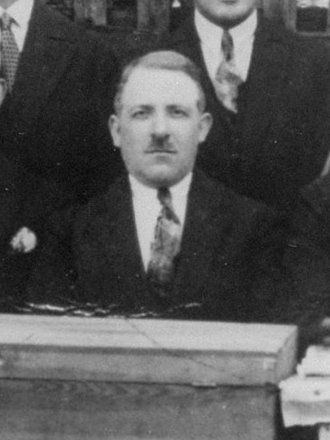
In memory of
Salomon Winter of Ozorków
Also written Solomon Winter
Communal leader, Zionist, and father of Cela Winter Dunkelman.
Welcome. This site gathers what is documented, and what his family remembers, about Salomon Winter, a Jewish communal leader in Ozorków, a textile town near Łódź in central Poland.
On 30 June 1929 he sat front and center with the town's election committee for the 16th Zionist Congress. A photograph of that day survives in the collection of the United States Holocaust Memorial Museum.
זכרונו לברכה May his memory be a blessing.
His life
We know Salomon Winter mainly through two kinds of evidence: a handful of records from 1929, and the recollections of his son-in-law, Luzer Dunkelman, recorded late in Luzer's life. His birth date, his parents, his wife's name and the date of his death have not yet been found in any record.
A man of the community
- Documented The Hebrew memorial book of Ozorków describes his chairmanship of the community council, and names a successor in about 1929–1930.
- Documented A 1929 report of the Łódź Chamber of Commerce names Salomon Winter as a member of Ozorków's local electoral commission.
- Documented On 30 June 1929 he was photographed with the Ozorków election committee for the 16th Zionist Congress. More below.
- Family memory Luzer remembered him as a communal leader in Ozorków.
- Family memory He was a supporter of Maccabi, the Jewish sports movement that was closely tied to Zionism.
- Family memory Luzer remembered him as a poker companion.
- Family memory He died before the Second World War, and Luzer recalled his funeral. The date has not been confirmed.
Timeline
- His daughter Cela (Chaja Cerka) is born.
- Photographed with Ozorków's election committee for the 16th Zionist Congress. Documented
- Named on Ozorków's local electoral commission in a Łódź Chamber of Commerce report. Documented
- The 16th Zionist Congress meets in Zurich. Context; there is no evidence he attended.
- The memorial book names a successor to his chairmanship of the community council. Documented
- His death and funeral, remembered by Luzer. Family memory
- Cela marries Luzer Dunkelman.
The centerpiece
Zionism and the election of 1929
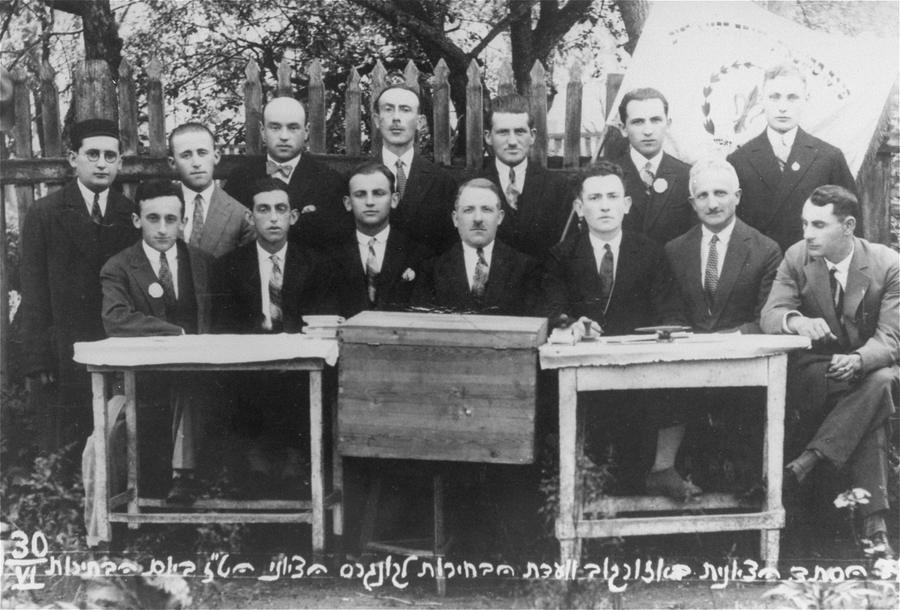
Who is in the photograph
The museum's catalog identifies four of the men by name. The numbers match the "Show who's who" markers on the photograph.
- Mr. Winter: front row, center, seated directly behind the wooden box.
- Mayer Zabner: front row, second from the right. He was the uncle of the woman who donated the photograph.
- Mr. Feldman: front row, far right.
- Mr. Rosenblum: front row, far left.
The other eleven men have not been identified. If you recognize someone, please tell us.
The inscription

Hand-lettered in Hebrew along the bottom of the print, the inscription reads roughly: The Central Election Committee for the 16th Zionist Congress in Ozorków
. It appears to add on election day
, and the date is written 30/VI, that is, 30 June. The first word is hard to read, so treat this as an approximate reading, not a certified translation.
What the committee did
Every two years or so, the World Zionist Organization elected a Congress, its parliament. Any Jew who bought the shekel, the movement's annual membership token, could vote. In Poland, as elsewhere, Zionists divided into competing parties, from the religious Zionists of Mizrachi to the labor Zionists and the Revisionists, and each put forward its own list of candidates.
Someone in every town had to make that vote happen. A local election committee registered voters, ran the polling and counted the ballots, so the competing lists could trust the result. In Ozorków in 1929, Salomon Winter was one of the men trusted with that job. In the photograph he sits behind the wooden box, which appears to be the ballot box.
The 16th Zionist Congress
The delegates chosen in elections like Ozorków's met in Zurich from 28 July to 11 August 1929. The Congress approved expanding the Jewish Agency for Palestine to include non-Zionist supporters. Jews who did not call themselves Zionists, but wanted to help build the Jewish home in the Land of Israel, would now share in leading the work. The enlarged Jewish Agency was founded in Zurich immediately after the Congress closed.
That summer was a turning point. A few weeks later, in late August 1929, deadly riots broke out in Palestine, including the massacre of Jews in Hebron.
Evidence and sources
Every documented statement on this site comes from one of the sources below. We will add fuller citations as copies of the originals are found.
-
USHMM photograph #04107
Group portrait of members of the Ozorkow election committee for the 16th Zionist Congress. Ozorków, 30 June 1929. United States Holocaust Memorial Museum Photo Archives, catalog record pa29346.
Credit line: United States Holocaust Memorial Museum, courtesy of Minia Wasilowska Moszenberg. Copyright: United States Holocaust Memorial Museum. Used here for noncommercial memorial purposes under the Museum's Terms of Use. The views and opinions on this site are the family's and do not necessarily reflect those of, nor imply endorsement by, the United States Holocaust Memorial Museum.
-
Łódź Chamber of Commerce report, 1929
Names Salomon Winter on Ozorków's local electoral commission. Full citation (title, page) to be added.
-
Ozorków memorial book (Hebrew)
Describes his chairmanship of the community council and names a successor in about 1929–1930. Page reference to be added.
-
Luzer Dunkelman's recorded interview
Luzer's recollections of Salomon Winter (roughly minutes 0:34–6:16 and 9:56, from Spanish captions) are the source of everything marked Family memory: the communal leader, the poker companion, the Maccabi supporter, and the death and funeral before the war.
-
Published obituaries
Obituaries of the Dunkelman family independently confirm Cela and Luzer's children and grandchildren.
Open questions
- The name of his wife, Cela's mother, and her family.
- His parents, birth date and birthplace.
- The exact date and place of his death and burial.
- Some family notes say he was vice-mayor of Ozorków in 1936–1937. We have not found a record of this, so it is not presented here as fact.
Family
Cela, his daughter, was born in 1919. After the Second World War she married Luzer Dunkelman, who was also from Ozorków. Together they built a family and a life far from Poland. Their story is told in the documentary Cela & Luzer: De la sombra a la luz, filmed in California in 2005.
Much of what we know about Salomon comes from Luzer, who spoke of his father-in-law in a recorded interview late in life. On her mother's side, Cela had a first cousin, Jaim: his father was her mother's brother.
Ozorków
Ozorków lies on the Bzura river, a short distance north of Łódź. In the nineteenth century it grew into a textile town, and its Jewish community grew with it, until Jews made up a large part of the town. Between the wars it had synagogues, Hasidic houses of prayer, schools, charities, Zionist parties and youth movements, the Bund and the sports clubs.
The Hebrew memorial book of Ozorków records that world: its rabbis and Hasidic leaders, its community council and its Zionist activists. Religious traditionalists and Zionists did not always agree, but together they made up the community that Salomon Winter served.
That community was destroyed in the Holocaust. Under German occupation the Jews of Ozorków were confined to a ghetto, and in 1942 most were deported and murdered. Luzer's sisters Rachel, Elka and Etka, and Rachel's children, were among those killed. Luzer survived and returned to Ozorków after the war, where a surviving cousin took him in.
Test comment to confirm comments publish immediately. <b>not bold</b> & "escaped". This will be deleted.
Site test (Cursor agent) ·